
By Kono Dumo Ukumo
May 12th 2026
In a recent visit to my home village, Mapel, a few kilometers from Wau the Capital town of Western Bahar El Ghazal state of South Sudan, I had some reflections on the situation of the youth and the village resident relatives. The daily routine of the youth and the able men of the surrounding villages is heart wrenching. Sitting and drinking in the market kiosks and tukuls or sitting and yawning under the market’s mango and Lulu trees.
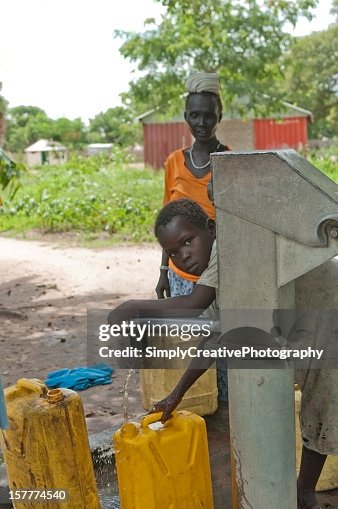
People using a borehole in Mapel.
It did not rain while I was in Mapel to see who would remain at home to put seeds on the ground and who would continue sitting akimbo in the local market. The spell of draught however could still provide window of opportunity for clearing the older farm or venture into a new ranch of bush, clearing it for expansion of the existing farmland.
Before hearing the repeated whining and complaining of what looks like abject poverty and endemic hunger, you would see some sort of desperation in the faces and posture of many youths. The tempting and easy to make excuses and complaints are the blame games against the well-known notorious and corrupt SPLM government, at both state and national level, where perpetuating insecurity, instigating intercommunal violences and its resultant multiple internal displacements seem to be the surest way to retain power and gunner into own pockets the limitless security budget of protracted insecurity.
Blaming the government or the ruling elites may not help much or effect any sound change in the status quo of these embattled grassroot dwellers. Not at all. The usual annual routine cycle is farming sorghum, ground nuts and little amounts of beans, okra, etc. The three month crops such as varieties of sorghum “Ajango” and ground nuts often become ready for harvesting and consumption by September and October. By February and March most of these crops are finished as most of them are sold cheaply in the local markets such as that of Mapel to get other household essentials or illicit local brews. Particularly lot of it is sold during Christmas season moods. By April to May, June and July the usual annual hunger period remains uncompromisingly harsh on families, especially those who remain adamant against farming cassava.
Those who farm cassava along with other crops, however, see the havoc created and the carnage perpetuated by the famine only in other families and neighboring households that kept repeating the boring excuses that there are no cassava stems or that they cannot cultivate cassava because cattle will destroy the cassava and many of such related imprudent and senseless excuses.
Food security experts of Food and Agricultural Organization of the United Nation (FAO) are known to have said “Communities that farm Cassava simply hear about famine, but never experience it”
I contacted ChatGPT (AI), asking for credible references and quotes confirming the above FAO assertion for African food security context, if any.
The search answer came as, yes, several highly credible institutions and experts – including the Food and Agriculture Organization (FAO), Consultative Group on International Agricultural Research (CGIAR), and International Fund for Agricultural Development – have emphasized cassava’s critical role in reducing chronic food insecurity in Africa, especially in drought-prone and conflict-affected communities.
Below are strong references and quotable statements instantly provided to me by AI:
“Cassava plays a food security role in areas prone to drought, famine and in periods of civil disturbances.”
— Food and Agriculture Organization, Cassava in Africa: Past, Present and Future
“Cassava could prove to be Africa’s ticket to food security under a changing climate.”
— CGIAR / CCAFS research report
“Cassava is a survivor crop. It can withstand harsh conditions – drought, heat or infertile soils.”
— CGIAR, Is cassava the key to tomorrow’s food security?
“Cassava has enormous commercial potential … and has been called a ‘Rambo root’ or ‘survivor’ crop.”
— CGIAR, Cassava and Climate Change
“Cassava’s huge potential as a 21st Century crop” can help sustainably increase yields and strengthen food safety net systems.
— Food and Agriculture Organization
A particularly useful policy-oriented statement from FAO is:
“Cassava roots can be harvested whenever there is a need or left in the ground when farmers are driven from their land by disturbances.”
AI says we could also synthesize these authorities into an academic-style statement such as:
According to the FAO and CGIAR, cassava is increasingly recognized as a strategic crop for combating persistent food insecurity in Africa because of its resilience to drought, poor soils, climate variability, and conflict-related disruptions to farming systems.
However, that is not all. The most important piece of information for the people of WBGS and related context is yet to come. The most important bomb shell of good news to the unemployed graduates and Senior four leavers who dwell the like of Mapel local market is that persistent farming of cassava for at least three years will as well fill pockets with cash. Remember, cash is hard to get now a days in South Sudan, worst still if you are from WBGS (in Juba) or live in WBGS.
Cassava is a renown and well-known subsistence food as well as cash crop in Africa for African rural disadvantaged lots. Fresh roots and processed products can be readily sold and remain on high demand in most African urban centers as well as rural settings. Additional good news is that the advantaged individuals in all the neighboring states to WBGS, unlike a few decades ago, do now-a-days eat cassava flour, roots and leaves. And they have money. Guys, isn’t that a reason to celebrate and farm cassava? How else would you best get that money, clean and with the sweat of thy braw.
REASONS SUPPORTING THE ARGUMENT THAT CASSAVA IS A CASH CROP INCLUDE:
- STRONG MARKET DEMAND
Cassava products such as cassava gari, flour, starch, chips, ethanol feedstock, and animal feed are widely traded in local and regional markets. - INCOME GENERATION FOR RURAL HOUSEHOLDS
Smallholder farmers often sell part of their harvest to pay school fees, buy school requirements, pay healthcare costs, transport, and farming expenses to sustain the farming. - INDUSTRIAL USE
Cassava is now linked to agro-processing industries, breweries, bakeries, and livestock feed production in countries such as Nigeria, Ghana, Kenya, Uganda and Tanzania. - RESILIENCE AND PROFITABILITY
Cassava tolerates drought and poor soils better than many crops, making it economically reliable for rural farmers under climate stress. - EMPLOYMENT CREATION
Processing, transport, and marketing of cassava create rural jobs beyond farm production itself.
POSSIBLE CHALLENGES OF FARMING CASSAVA
A balanced discussion on cassava farming should note that:
- In remote rural areas with weak market access, cassava may still remain mainly a viable and vital food-security crop which is as well a great role to play in heart wrenching context such as rural South Sudan of WBGS.
- Prices can fluctuate due to perishability and poor storage infrastructure and poor feeder road network.
- Some households prioritize household consumption before commercial sale. This looks like an advantage disguised as disadvantage. After all it is better to have something to eat rather than wallowing in protracted poverty and hunger as well.
A STRONGER ACADEMIC CONCLUSION WOULD BE:
Cassava in Africa has evolved from being primarily a subsistence crop into both a food-security and cash crop, especially where market systems, processing industries, and transport networks support commercialization. These are for sure good news for guys in Mapel and related contexts in WBGS and South Sudan at large. It looks like this is better than choosing to age poor and hungry in village market tukuls and ramshackled Rakubas such as in those Mapel Market and related village context?
This news is particularly important for WBGS as it’s population remains sidelined and marginalized in the feasting spree over Government opportunities and important national resource allocations and opportunities such as government contracts, dockets and lucrative assignments.
Citizens of the state can still get those resources denied from them if they embark on sustainable farming with crops that demonstrated ability for being both a cash crop and reliable for providing stable source of food security. Why then insist on choosing poverty at the gate of abundance?